

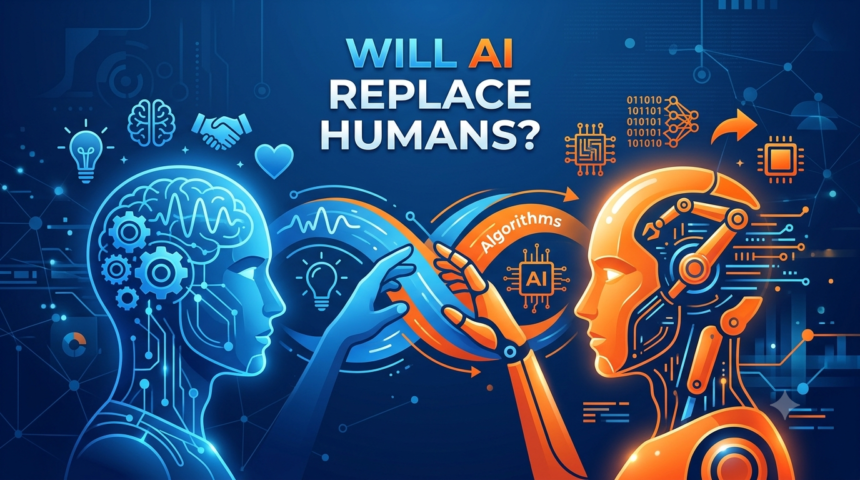
Artificial Intelligence, commonly known as AI, has become one of the most talked about technologies in the world. From writing articles and creating images to helping doctors diagnose diseases and assisting programmers with coding, AI is changing the way we work and live. Because of these rapid advancements, many people are asking an important question: Will AI replace humans?
The short answer is no, at least not completely. AI is becoming more powerful every year, but it still has many limitations. Instead of replacing all humans, AI is more likely to change the way people work by automating repetitive tasks while creating new opportunities and careers.
In this article, we will explore whether AI can truly replace humans, its positive and negative impacts, and what the future may look like.
What Is Artificial Intelligence?
Artificial Intelligence refers to computer systems that can perform tasks that normally require human intelligence. These tasks include learning from data, recognizing patterns, understanding language, solving problems, and making predictions.
Popular AI tools like ChatGPT, Google Gemini, Claude, and GitHub Copilot have made AI accessible to millions of people. Businesses, students, developers, teachers, and content creators use AI every day to improve productivity and save time.
Although AI can perform many impressive tasks, it does not think or feel the way humans do.
Why Do People Think AI Will Replace Humans?
Many people believe AI will replace humans because it can complete certain tasks much faster than people.
For example, AI can:
- Write articles in seconds
- Generate computer code
- Analyze large amounts of data
- Translate multiple languages
- Create images and videos
- Answer customer questions
- Detect patterns in medical reports
These abilities make AI seem incredibly powerful. However, speed alone does not mean AI can replace human intelligence completely.
Can AI Really Replace Humans?
The answer is more complicated than a simple yes or no.
AI can replace some repetitive and predictable tasks. Jobs that involve entering data, organizing information, or answering common customer questions may become increasingly automated.
However, there are many things AI cannot truly replace.
Humans possess creativity, emotions, empathy, ethical judgment, personal experiences, and critical thinking. AI can imitate these qualities to some extent, but it does not genuinely understand emotions or experience the world like humans.
For example, an AI can write a poem about sadness, but it has never actually felt sadness.
A doctor can comfort a worried patient with compassion. A teacher can inspire students through personal experiences. A leader can make difficult ethical decisions during uncertain situations. These human qualities remain extremely difficult for AI to replicate.
Industries Being Changed by AI
AI is already transforming many industries around the world.
Healthcare
Doctors use AI to analyze medical images, predict diseases, and assist in diagnosis. AI speeds up research and helps medical professionals make informed decisions, but doctors still make the final judgment and care for patients.
Education
Teachers use AI to create quizzes, lesson plans, and personalized learning materials. Students benefit from instant explanations and tutoring, but teachers continue to play an important role in guiding and motivating learners.
Software Development
Developers use AI coding assistants to write code faster, detect bugs, and improve productivity. AI helps programmers work more efficiently rather than replacing them completely.
Customer Support
Many businesses now use AI chatbots to answer common questions. This reduces waiting times for customers while allowing human support agents to focus on more complicated problems.
Content Creation
Writers, designers, and marketers use AI to brainstorm ideas, edit content, and create graphics. Human creativity, storytelling, and originality remain valuable because audiences appreciate authentic content.
Positive Impacts of AI
Artificial Intelligence offers many benefits when used responsibly.
Increased Productivity
AI automates repetitive tasks, allowing people to focus on creative and strategic work.
Better Decision Making
Businesses use AI to analyze large datasets and identify trends that humans might overlook.
Improved Healthcare
AI helps detect diseases earlier, supports medical research, and improves patient care.
Personalized Learning
Students can receive customized explanations based on their learning speed and individual needs.
Faster Innovation
Scientists and engineers use AI to accelerate research in medicine, engineering, and environmental science.
Negative Impacts of AI
Despite its advantages, AI also brings important challenges.
Job Displacement
Some routine jobs may disappear as businesses automate repetitive tasks. Workers may need to learn new skills to remain competitive.
Misinformation
AI can generate convincing but incorrect information, making it important to verify facts through reliable sources.
Privacy Concerns
Many AI systems rely on large amounts of data. Protecting personal information remains a major challenge.
Bias
AI systems learn from existing data. If that data contains bias, AI may produce unfair or inaccurate results.
Overdependence
Relying too heavily on AI can reduce problem-solving skills and independent thinking if people stop learning and verifying information themselves.
Jobs That Are Least Likely to Be Replaced
Some careers rely heavily on human interaction, creativity, and judgment.
Examples include:
- Doctors
- Nurses
- Teachers
- Psychologists
- Social workers
- Skilled tradespeople
- Scientists
- Entrepreneurs
- Artists
- Business leaders
AI may assist these professionals, but it is unlikely to replace them entirely.
Jobs That May Change the Most
Some professions are more likely to see major changes because of AI.
These include:
- Data entry
- Basic customer support
- Administrative work
- Simple bookkeeping
- Routine programming tasks
- Basic content generation
Even in these fields, many workers will transition into roles that require supervising, improving, or collaborating with AI systems.
How Humans Can Stay Relevant
Instead of fearing AI, people should focus on developing skills that machines cannot easily replicate.
These include:
- Critical thinking
- Creativity
- Communication
- Leadership
- Emotional intelligence
- Problem solving
- Adaptability
- Continuous learning
People who combine these skills with AI tools will likely have the greatest opportunities in the future.
What Does the Future Look Like?
The future will most likely involve collaboration between humans and AI.
Businesses will continue using AI to automate repetitive tasks, while humans handle creativity, relationships, ethical decisions, and complex problem solving.
New careers will emerge, including AI trainers, AI ethics specialists, prompt engineers, AI consultants, and machine learning experts.
Throughout history, technological advancements have changed the nature of work rather than eliminating human value. AI is expected to follow a similar path by transforming jobs instead of replacing humanity.
Final Thoughts
So, will AI replace humans? The evidence suggests that the answer is no. AI will replace certain tasks and change many industries, but it cannot fully replace the creativity, empathy, judgment, and unique experiences that define human beings.
The smartest approach is not to compete against AI but to learn how to work alongside it. People who understand AI and use it responsibly will be better prepared for the future than those who ignore it.
Artificial Intelligence is one of the most powerful technologies ever created. When combined with human intelligence, creativity, and ethical decision making, it has the potential to improve lives, solve complex problems, and create opportunities that were once impossible.
The future belongs not to AI alone and not to humans alone, but to those who know how to combine the strengths of both.